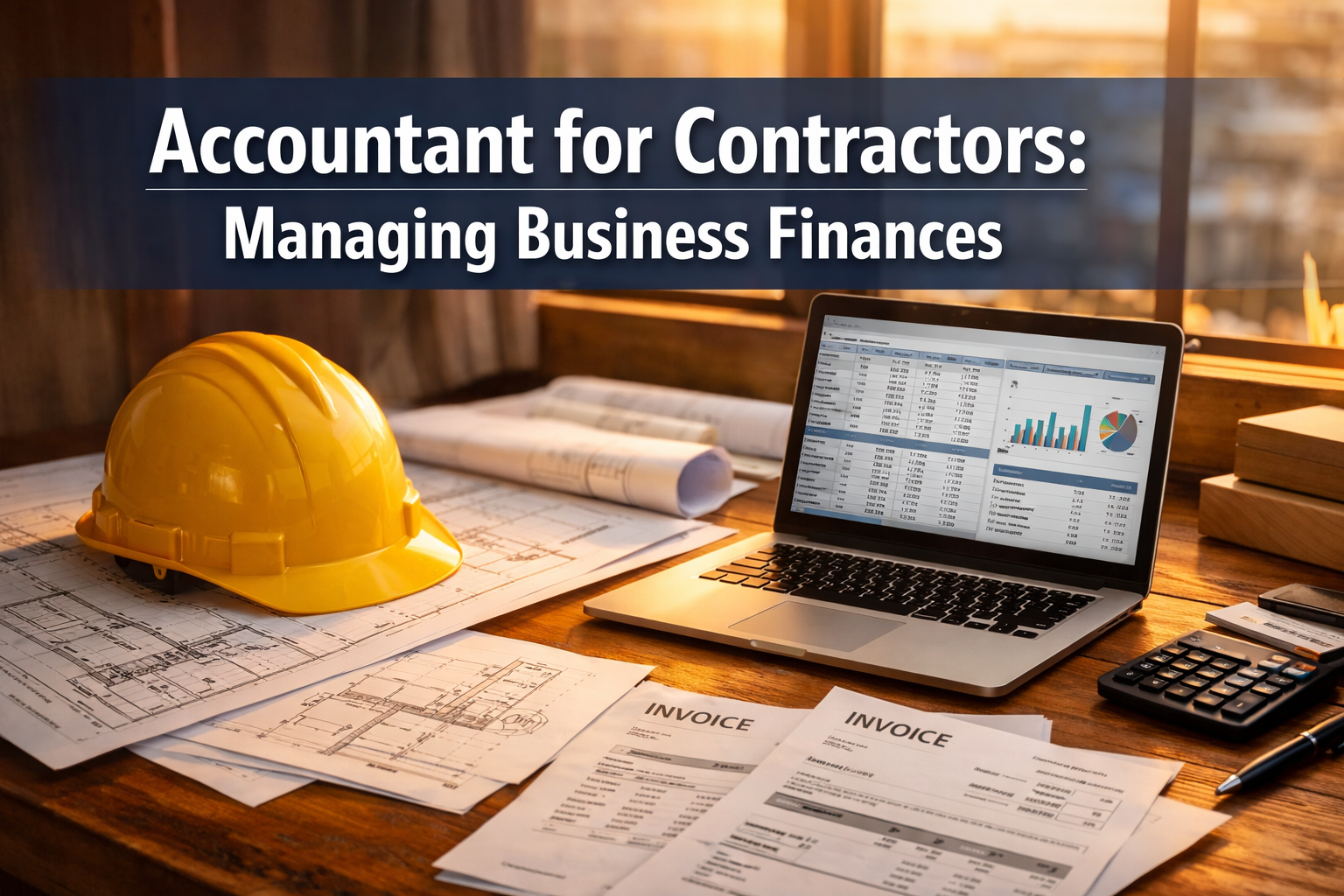
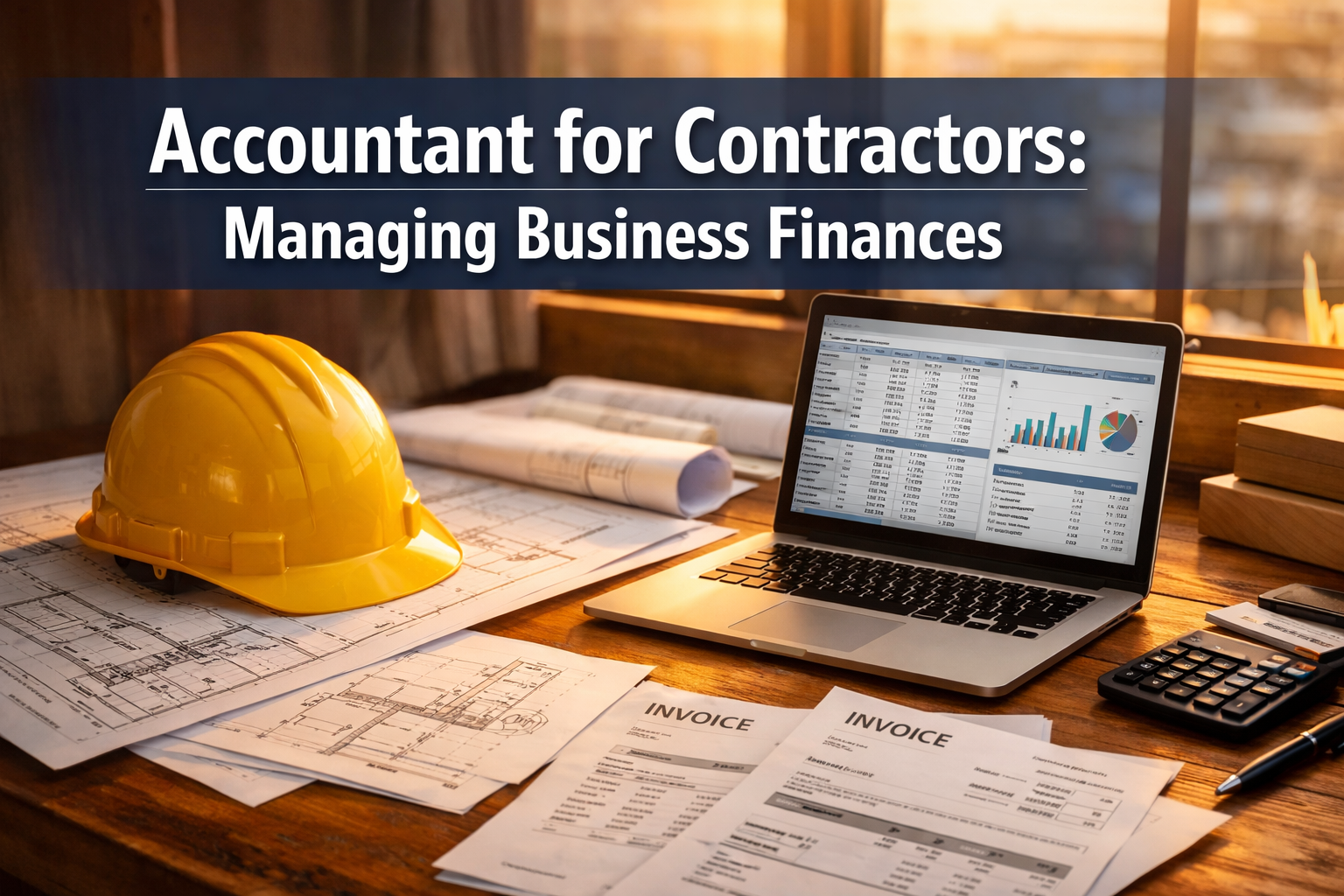
Accountant for Contractors: Managing Business Finances
Last updated: March 6, 2026
Contractors face financial challenges that most other businesses don’t. Between tracking costs across multiple job sites, managing subcontractor payments, handling fluctuating cash flow, and staying compliant with tax rules, the financial side of contracting work can get complicated fast. An accountant for contractors who specializes in managing business finances can be the difference between a profitable operation and one that’s constantly scrambling to make payroll. This guide covers what contractor accounting involves, when you need professional help, and how to find the right fit for your business.
Key Takeaways
- Contractors have unique accounting needs, including job costing, progress billing, and managing payments to subcontractors.
- A professional tax accountant who understands contracting can help you claim all eligible deductions and avoid costly IRS issues.
- Bookkeeping services for small business contractors should track income and expenses on a per-project basis, not just overall.
- The right accountant will help with estimated quarterly tax payments, which most contractors are required to make.
- Construction-specific accounting methods (like percentage-of-completion) require specialized knowledge.
- Hiring an accountant typically pays for itself through tax savings, fewer errors, and better financial decision-making.
- Both local tax accountants and virtual bookkeeping services can serve contractors effectively in 2026.
Quick Answer

An accountant for contractors handles the specific financial tasks that come with project-based work: job costing, progress billing, subcontractor compliance (1099 filings), equipment depreciation, and tax planning around irregular income. Most contractors benefit from hiring a professional tax accountant once their annual revenue exceeds $75,000 to $100,000, or sooner if they employ subcontractors or work across multiple states. The cost typically ranges from $150 to $450 per month for ongoing bookkeeping and tax preparation services, depending on the complexity of your operation.

Why Do Contractors Need a Specialized Accountant?
General accounting principles apply to every business, but contractors deal with financial situations that require industry-specific knowledge. A standard bookkeeper may not understand how to properly allocate costs across multiple active projects or handle retainage accounting.
Here’s what makes contractor finances different:
- Project-based revenue: Income arrives in chunks tied to project milestones, not in steady monthly payments. This creates cash flow gaps that need careful management.
- Job costing: Every project needs its own profit-and-loss tracking. You need to know if a specific job made money or lost it, not just whether the business is profitable overall.
- Subcontractor payments and 1099 compliance: If you pay subcontractors more than $600 in a year, you must file 1099-NEC forms. Missing these can trigger IRS penalties.
- Equipment depreciation: Heavy equipment, tools, and vehicles represent significant capital investments. Section 179 deductions and bonus depreciation rules change frequently.
- Multi-state tax obligations: Contractors who work across state lines may owe taxes in multiple jurisdictions.
- Bonding and insurance requirements: Many contracts require proof of financial stability. Clean, accurate books make bonding applications smoother.
A small business tax accountant with construction or contracting experience understands these issues and can set up systems to handle them from day one. If you’re unsure whether your business needs this kind of support, our guide on when to hire an accountant for your small business covers the key decision points.
What Services Does an Accountant for Contractors Provide?
An accountant for contractors managing business finances typically offers a bundle of services tailored to the contracting industry. Not every contractor needs all of them, but here are the core offerings:
Bookkeeping and Job Costing
Day-to-day bookkeeping for contractors goes beyond recording transactions. It includes:
- Tracking labor, materials, and overhead costs per project
- Categorizing expenses by job site
- Reconciling bank and credit card statements
- Managing accounts payable and receivable on a project basis
For contractors running multiple jobs at once, bookkeeping services for contractors that specialize in project tracking are essential.
Tax Preparation and Planning
Contractor tax returns are more complex than typical small business filings. Your accountant should handle:
- Quarterly estimated tax payments (Form 1040-ES)
- Annual tax return preparation (Schedule C for sole proprietors, or business entity returns)
- 1099-NEC filing for all subcontractors
- Tax deduction identification for tools, equipment, vehicle use, home office, insurance premiums, and more
- Entity structure advice (sole proprietorship vs. LLC vs. S-Corp) based on your income level
A good tax accountant doesn’t just file your return. They plan throughout the year to minimize your tax burden legally. Learn more about how tax accountants help with business tax planning.
Payroll Services
If you have employees (not just subcontractors), payroll adds another layer of complexity:
- Calculating and withholding federal, state, and local taxes
- Filing payroll tax returns (Forms 941, 940)
- Managing workers’ compensation reporting
- Handling certified payroll for government contracts (Davis-Bacon Act compliance)
Financial Reporting and Cash Flow Management
Contractors need regular financial reports to make smart decisions:
| Report | What It Shows | How Often |
|---|---|---|
| Job Cost Report | Profit/loss per project | Per project or monthly |
| Cash Flow Statement | Money coming in vs. going out | Monthly |
| Profit & Loss Statement | Overall business profitability | Monthly or quarterly |
| Balance Sheet | Assets, liabilities, equity | Quarterly |
| Accounts Receivable Aging | Who owes you and how long overdue | Weekly or biweekly |
Common mistake: Many contractors look only at their bank balance to gauge financial health. This is misleading because it doesn’t account for outstanding bills, upcoming material costs, or retainage held back by clients.
How Does an Accountant Help Contractors Save on Taxes?
The right accountant can reduce your tax bill significantly by making sure you claim every deduction you’re entitled to and by structuring your business in a tax-efficient way.
Key deductions contractors often miss:
- Vehicle expenses: Either actual costs or the standard mileage rate (check IRS guidance for the current year’s rate)
- Home office deduction: If you have a dedicated space for administrative work
- Tool and equipment purchases: Section 179 allows immediate expensing of qualifying equipment up to annual limits
- Self-employment tax deduction: You can deduct half of your self-employment tax on your income tax return
- Health insurance premiums: Self-employed contractors can often deduct 100% of premiums
- Retirement contributions: SEP-IRA or Solo 401(k) contributions reduce taxable income
- Continuing education and licensing fees: Trade certifications, safety courses, and license renewals
Entity structure matters too. A sole proprietor earning $150,000 in net profit pays self-employment tax on the entire amount. An S-Corp election allows you to pay yourself a reasonable salary and take the remaining profit as a distribution, which isn’t subject to self-employment tax. The savings can be $5,000 to $15,000 per year depending on income, but the S-Corp structure adds administrative costs and compliance requirements. Your accountant can run the numbers to see if it makes sense for your situation.
For a broader look at how professionals in this space help reduce what you owe, see can a tax accountant help reduce your tax bill.
When Should a Contractor Hire an Accountant?
Hire an accountant before problems start, not after. Here are the clearest signals it’s time:
- You’re paying subcontractors. 1099 compliance errors trigger IRS penalties, and misclassifying employees as subcontractors can result in back taxes, interest, and fines.
- Your annual revenue exceeds $75,000 to $100,000. At this level, the tax complexity and potential savings justify professional help.
- You’re spending more than 5 hours per month on bookkeeping. That time is better spent on billable work.
- You’ve received an IRS notice or are behind on estimated payments. An accountant can help you get current and set up a system to stay that way.
- You’re considering a business entity change. Moving from sole proprietorship to LLC or S-Corp has tax and legal implications that need professional guidance.
- You’re bidding on larger contracts. Bigger jobs often require financial statements, bonding, and proof of fiscal responsibility.
Choose a specialized accountant if you work in construction, electrical, plumbing, HVAC, landscaping, or any trade where project-based billing and subcontractor management are standard. Choose a general small business accountant if your contracting work is simpler (for example, a solo handyman with no employees or subs).
Our resource on what services contractors need from an accountant breaks this down further.

How Much Does an Accountant for Contractors Cost?
Costs vary based on your business size, the services you need, and whether you work with a local firm or a virtual provider. Here’s a general breakdown:
| Service | Typical Cost Range (2026) |
|---|---|
| Monthly bookkeeping (solo contractor) | $150–$300/month |
| Monthly bookkeeping (contractor with employees) | $300–$600/month |
| Annual tax return preparation (Schedule C) | $300–$600 |
| Annual tax return (S-Corp or partnership) | $800–$2,000 |
| Quarterly estimated tax calculations | Often included in monthly packages |
| Payroll processing | $50–$150/month + per-employee fees |
| 1099 preparation and filing | $5–$25 per form |
Note: These are general estimates based on common market pricing. Your actual costs will depend on your location, the complexity of your finances, and the firm you choose. For a more detailed look at pricing, see our guide on tax accountant fees explained.
Decision rule: If hiring an accountant costs $3,000 to $5,000 per year but saves you $5,000 or more in taxes, reduces your bookkeeping time by 60+ hours annually, and prevents costly compliance mistakes, the investment pays for itself.
How to Find the Right Accountant for Your Contracting Business

Not all accountants understand contracting. Here’s a step-by-step process to find one who does:
Step 1: Define What You Need
Before you start searching, list your specific needs:
- Monthly bookkeeping with job costing
- Tax preparation and filing
- Quarterly estimated tax payments
- 1099 preparation for subcontractors
- Payroll processing
- Financial statements for bonding
- Cash flow forecasting
- Tax planning and entity structure advice
Step 2: Look for Industry Experience
Ask potential accountants:
- How many contractor or construction clients do they currently serve?
- Are they familiar with job costing software (like QuickBooks for Contractors, Foundation Software, or Sage 100 Contractor)?
- Do they understand percentage-of-completion vs. completed-contract accounting methods?
- Can they help with certified payroll if needed?
Step 3: Decide Between Local and Virtual
Choose local if you prefer face-to-face meetings, need someone familiar with your specific city or county tax rules, or want to drop off documents in person. You can search for local tax accountants near you through our directory.
Choose virtual if you’re comfortable with cloud-based tools, want potentially lower fees, or need flexibility in scheduling. Virtual bookkeeping services and online accounting have become standard for contractors who are comfortable sharing documents digitally.
Step 4: Check Credentials and Reviews
Look for:
- CPA (Certified Public Accountant) designation for tax preparation and financial statement work
- EA (Enrolled Agent) designation for tax-focused services
- QuickBooks ProAdvisor or similar software certifications
- Online reviews from other contractors or construction businesses
- Professional memberships (AICPA, state CPA societies)
Step 5: Compare Pricing and Service Packages
Get quotes from at least three providers. Make sure you’re comparing the same scope of services. Some firms offer all-inclusive monthly packages, while others charge separately for each service.
What Are Common Financial Mistakes Contractors Make?
Even experienced contractors make financial errors that cost them money. Here are the most frequent ones an accountant can help you avoid:
1. Mixing personal and business finances. This is the single most common issue. Use a separate business bank account and credit card for all business transactions. Period.
2. Not tracking expenses by project. If you can’t tell which jobs are profitable and which aren’t, you can’t price future work accurately.
3. Underestimating tax obligations. Self-employment tax alone is 15.3% on top of income tax. Contractors who don’t make quarterly estimated payments face underpayment penalties.
4. Misclassifying workers. The IRS has specific rules about who qualifies as an independent contractor vs. an employee. Getting this wrong can result in back taxes, penalties, and interest.
5. Ignoring cash flow timing. A job might be profitable on paper but still cause cash flow problems if you’re paying for materials and labor weeks before the client pays you.
6. Failing to keep receipts. Without documentation, you can’t defend deductions in an audit. Digital receipt tracking apps make this much easier in 2026.
7. Not planning for slow seasons. Many contractors have seasonal income fluctuations. An accountant can help you budget and set aside reserves during busy months.
For more on why professional financial support matters, read why small businesses should work with a tax accountant.
Accountant for Contractors: Managing Business Finances With the Right Tools
Your accountant is only as effective as the systems supporting them. Here are the tools and practices that make contractor accounting work smoothly:
Accounting software options for contractors:
- QuickBooks Online (with Projects feature): Good for small to mid-size contractors. Widely supported by accountants.
- QuickBooks Desktop (Contractor Edition): More robust job costing features than the online version.
- Foundation Software: Built specifically for construction companies. Best for mid-size to large operations.
- Sage 100 Contractor: Another construction-specific option with strong job costing and payroll features.
- FreshBooks: Simpler option for solo contractors who primarily need invoicing and expense tracking.
Best practices for working with your accountant:
- Share access to your accounting software so they can review transactions in real time
- Submit receipts weekly using a digital tool (many accountants use Dext, Hubdoc, or similar apps)
- Schedule monthly or quarterly check-ins to review financial reports
- Provide subcontractor W-9 forms as soon as you hire someone new
- Communicate about large purchases or changes in business structure before they happen, not after
Should You Choose a CPA, EA, or General Accountant?
This depends on what you need most:
| Professional | Best For | Typical Cost | Can Represent You in IRS Audit? |
|---|---|---|---|
| CPA (Certified Public Accountant) | Full-service accounting, financial statements, tax planning, bonding support | Higher | Yes |
| EA (Enrolled Agent) | Tax preparation and planning, IRS issue resolution | Moderate | Yes |
| General Accountant/Bookkeeper | Day-to-day bookkeeping, basic tax prep | Lower | Limited |
Choose a CPA if you need audited or reviewed financial statements (often required for bonding or large contracts), want comprehensive tax planning, or have a complex business structure.
Choose an EA if your primary concern is tax preparation and you want someone who specializes in tax law and can represent you before the IRS.
Choose a bookkeeper if you mainly need help keeping your books organized and can handle tax filing yourself or with seasonal tax preparation services.
Many contractors use a combination: a bookkeeper for monthly work and a CPA or EA for annual tax preparation and planning.
Conclusion
Managing business finances as a contractor requires more attention to detail than most other small businesses. Between job costing, subcontractor compliance, equipment depreciation, and the irregular cash flow that comes with project-based work, there’s a lot that can go wrong without proper financial management.
Your next steps:
- Assess your current situation. Are you tracking costs per project? Are your quarterly estimated taxes current? Do you have clean, organized books?
- Identify your gaps. Maybe you need full-service accounting, or maybe you just need bookkeeping services for small business operations with annual tax prep.
- Search for a qualified professional. Look for accountants with contracting or construction experience. Use our directory to find tax accountants who understand your industry.
- Set up proper systems. Get the right software, separate your personal and business finances, and establish a routine for submitting receipts and reviewing reports.
- Plan year-round, not just at tax time. The best financial outcomes come from ongoing tax planning and regular financial reviews, not a once-a-year scramble.
The right accountant for contractors doesn’t just manage your business finances. They give you the clarity and confidence to bid on bigger jobs, invest in your business, and keep more of what you earn.
Frequently Asked Questions
Q: Can I do my own accounting as a contractor?
Yes, but it becomes risky as your business grows. Solo contractors with simple finances can use accounting software and handle basic bookkeeping. Once you hire subcontractors, take on multiple projects, or earn above $75,000 to $100,000 annually, professional help is strongly recommended.
Q: How often should a contractor meet with their accountant?
At minimum, quarterly. Monthly meetings are better if you’re actively managing multiple projects. Many accountants offer virtual check-ins that take 15 to 30 minutes and focus on cash flow, upcoming tax obligations, and any financial concerns.
Q: Do I need an accountant if I use QuickBooks?
QuickBooks is a tool, not a strategy. The software records transactions, but an accountant interprets the data, ensures accuracy, identifies tax savings, and provides financial advice. Most accountants work directly within QuickBooks alongside you.
Q: What’s the difference between job costing and regular accounting?
Regular accounting tracks overall business income and expenses. Job costing breaks down revenue, labor, materials, and overhead for each individual project so you can see which jobs are profitable and which aren’t. This is critical for accurate bidding on future work.
Q: Should I form an LLC or S-Corp as a contractor?
It depends on your income level and goals. An LLC provides liability protection. An S-Corp election (which can be made by an LLC) can save on self-employment taxes once your net income exceeds roughly $40,000 to $50,000, but it adds compliance costs. An accountant can model both scenarios with your actual numbers.
Q: What records should I keep and for how long?
Keep all financial records, including receipts, invoices, bank statements, tax returns, and 1099 forms, for at least seven years. The IRS can audit returns up to three years back (six years if they suspect underreported income), and some state requirements are longer.
Q: Are subcontractor payments tax-deductible?
Yes. Payments to subcontractors are a deductible business expense. However, you must file 1099-NEC forms for any subcontractor you pay $600 or more in a calendar year. Failure to file can result in penalties.
Q: Can a virtual accountant handle contractor finances effectively?
Absolutely. Virtual bookkeeping services and online accounting firms handle contractor finances effectively using cloud-based software. The key is choosing a provider with contracting industry experience, regardless of whether they’re local or remote.
Q: What happens if I haven’t been making quarterly estimated tax payments?
You’ll likely owe underpayment penalties and interest when you file your annual return. An accountant can calculate what you owe, help you get current, and set up a system for future quarterly payments to avoid this issue going forward.
Q: How do I handle retainage in my accounting?
Retainage (the percentage of payment held back until project completion) should be tracked as a receivable on your books. It’s not recognized as income until you have the right to receive it, depending on your accounting method. This is one area where construction-specific accounting knowledge is essential.
References
- IRS. “Self-Employment Tax (Social Security and Medicare Taxes).” IRS.gov, 2025. https://www.irs.gov/businesses/small-businesses-self-employed/self-employment-tax-social-security-and-medicare-taxes
- IRS. “Instructions for Forms 1099-MISC and 1099-NEC.” IRS.gov, 2024. https://www.irs.gov/instructions/i1099mec
- IRS. “Section 179 Deduction.” IRS.gov, 2025. https://www.irs.gov/newsroom/section-179-deduction
- IRS. “Estimated Taxes.” IRS.gov, 2025. https://www.irs.gov/businesses/small-businesses-self-employed/estimated-taxes
Tags: accountant for contractors, contractor accounting, construction accounting, small business tax accountant, job costing, subcontractor 1099 filing, contractor bookkeeping, tax planning for contractors, self-employed tax preparation, CPA for contractors, contractor financial management, quarterly estimated taxes
Disclaimer: The information on this website is for general informational purposes only and does not constitute tax or accounting advice.
Users should consult a qualified tax or accounting professional for advice specific to their situation.