

Accountant for Online Business Owners: Financial Tips

Last updated: March 6, 2026
Running an online business means you’re already juggling product development, marketing, customer service, and probably a dozen other things before lunch. The financial side, including taxes, bookkeeping, and cash flow management, often gets pushed to the bottom of the list until a deadline forces it back to the top. That’s exactly where an accountant for online business owners becomes essential, and the financial tips in this guide will help you understand what to prioritize, when to get professional help, and how to avoid the mistakes that cost digital entrepreneurs real money.
Whether you sell on Shopify, run a consulting practice through your website, or earn income from multiple online platforms, the financial rules that apply to you are different from those of a traditional brick-and-mortar shop. This article breaks down the specific financial strategies, tax considerations, and professional support options that matter most for online business owners in 2026.
Key Takeaways
- Online businesses face unique tax situations including sales tax nexus in multiple states, digital product taxation, and platform-reported income (1099-K thresholds).
- Separating personal and business finances is the single most important first step for any online entrepreneur.
- Quarterly estimated tax payments are required for most self-employed online business owners; missing them triggers IRS penalties.
- A professional tax accountant experienced with ecommerce can identify deductions you’re likely missing, such as home office, software subscriptions, and payment processing fees.
- Bookkeeping should happen weekly or biweekly, not once a year before tax season.
- Virtual bookkeeping services and online accountants are well-suited for digital businesses because they already operate in a cloud-based environment.
- Entity structure matters: choosing between sole proprietorship, LLC, or S-corp affects how much self-employment tax you pay.
- You don’t need to wait until you’re “big enough” to hire an accountant; even part-time online sellers benefit from professional guidance.
Quick Answer

An accountant for online business owners handles the specific financial challenges of digital commerce: multi-state sales tax compliance, platform income reporting, digital product taxation, and deduction tracking for expenses like software, advertising, and home office use. The best financial tip for any online entrepreneur is to get professional help early, keep business and personal finances completely separate, and stay on top of quarterly tax obligations. You don’t need a massive revenue number to justify working with a small business tax accountant or CPA.

Why Do Online Business Owners Need a Specialized Accountant?
Online businesses have financial complexities that general accountants may not encounter regularly. A tax professional who understands ecommerce, digital services, and platform-based income will save you more money and prevent more problems than a generalist.
Here’s what makes online business finances different:
- Multi-state sales tax obligations. If you sell physical products online, you may owe sales tax in states where you have economic nexus, even if you’ve never set foot there. After the 2018 South Dakota v. Wayfair Supreme Court decision, most states can require out-of-state sellers to collect sales tax once they exceed certain revenue or transaction thresholds.
- Platform income reporting. Marketplaces like Amazon, Etsy, and Shopify report your income to the IRS. Starting with tax year 2024, the 1099-K reporting threshold dropped significantly, meaning more online sellers receive these forms.
- Digital product taxation. Whether digital downloads, SaaS subscriptions, or online courses are taxable depends on the state. The rules vary widely and change frequently.
- International transactions. Selling to customers abroad or hiring overseas contractors introduces currency conversion, foreign tax considerations, and additional reporting requirements.
A professional tax accountant who works with online businesses regularly will already know these rules. If you’re unsure what to expect when working with an accountant for your online business, it’s worth learning the basics before your first meeting.
Common mistake: Assuming that because a platform collects sales tax on your behalf, you have no further sales tax obligations. Many platforms only collect in certain states, and you may still need to file returns.
What Financial Tips Matter Most for Online Entrepreneurs?
The most impactful financial tips for online business owners center on organization, tax planning, and knowing which expenses are deductible. Getting these right from the start prevents expensive corrections later.
1. Separate Business and Personal Finances Immediately
Open a dedicated business bank account and get a business credit card. Use them exclusively for business transactions. This single step makes bookkeeping dramatically easier, protects your personal assets (especially if you’re an LLC), and gives you clean records if you’re ever audited.
2. Track Every Business Expense in Real Time
Don’t wait until December to sort through a year’s worth of transactions. Use accounting software like QuickBooks, Xero, or Wave, and categorize expenses as they happen. Common deductible expenses for online businesses include:
| Expense Category | Examples |
|---|---|
| Software & tools | Shopify fees, email marketing platforms, design tools, project management apps |
| Advertising | Facebook ads, Google Ads, influencer payments, sponsored content |
| Payment processing | Stripe fees, PayPal fees, credit card processing charges |
| Home office | Portion of rent/mortgage, utilities, internet (based on dedicated space) |
| Professional services | Accountant fees, legal fees, virtual assistant payments |
| Shipping & fulfillment | Packaging materials, postage, warehouse fees |
| Education | Courses, conferences, and books directly related to your business |
| Website costs | Hosting, domain registration, SSL certificates, web development |
3. Pay Quarterly Estimated Taxes
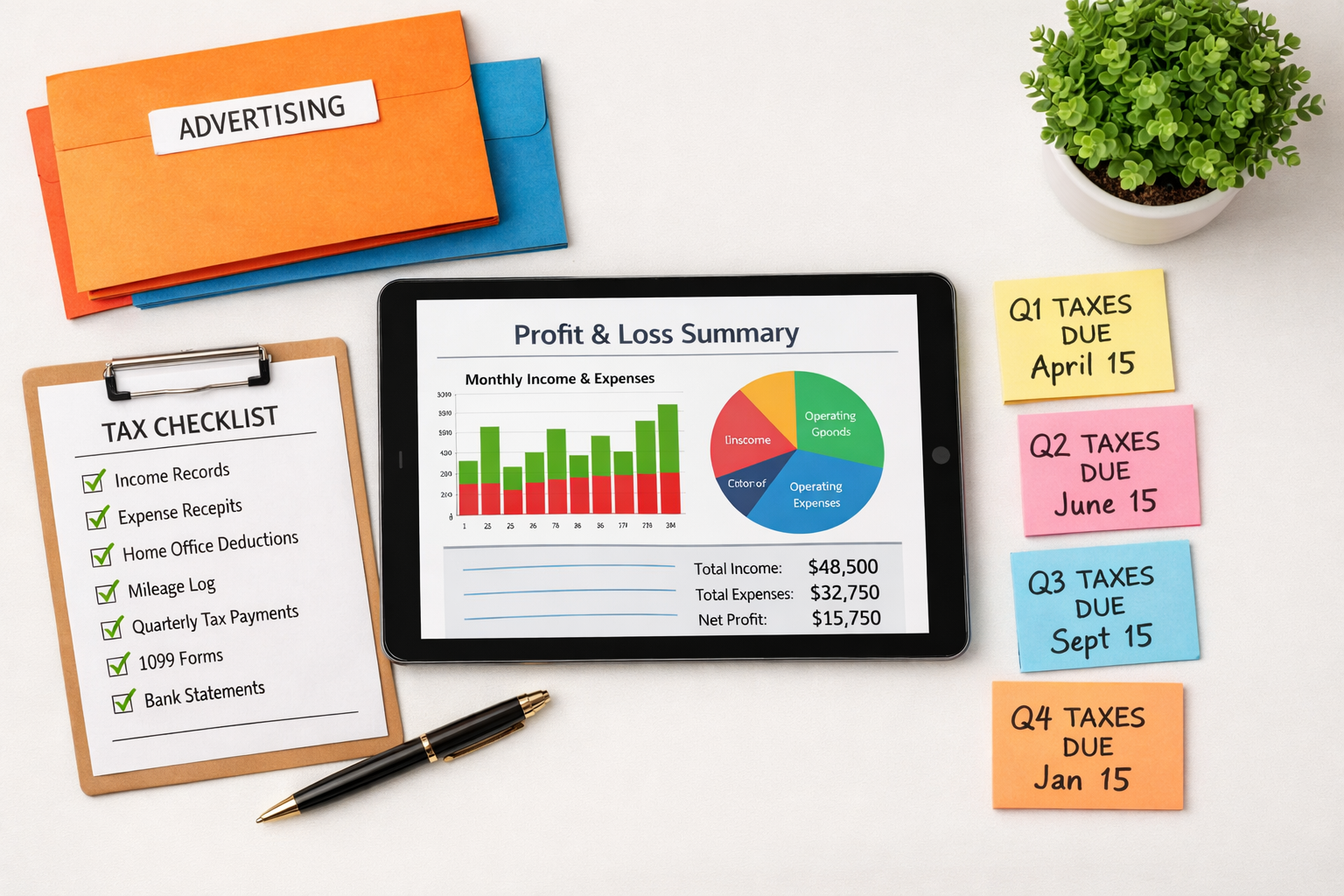
If you expect to owe $1,000 or more in federal taxes for the year, the IRS requires quarterly estimated payments. The due dates are typically April 15, June 15, September 15, and January 15 of the following year. Missing these deadlines results in underpayment penalties, even if you pay everything at filing time.
4. Understand Your Entity Structure Options
Many online business owners start as sole proprietors by default. As your income grows, switching to an LLC taxed as an S-corporation can reduce self-employment tax. For example, if your business nets $100,000, an S-corp election lets you pay yourself a reasonable salary (say $60,000) and take the remaining $40,000 as a distribution, which isn’t subject to the 15.3% self-employment tax. An accountant can help you determine whether an LLC structure is right for your situation.
5. Keep a Cash Reserve
Online business income is often irregular. Set aside at least three months of operating expenses plus your estimated quarterly tax payments. This buffer prevents you from dipping into tax money when revenue dips.
How Does an Accountant for Online Business Owners Help With Taxes?
An accountant helps online business owners minimize tax liability legally, stay compliant with filing requirements, and avoid costly mistakes. The specific ways they help include:
Tax planning throughout the year. Rather than scrambling at tax time, a good accountant reviews your financials quarterly and recommends strategies like timing large purchases, maximizing retirement contributions (SEP-IRA, Solo 401k), or adjusting your estimated payments.
Identifying overlooked deductions. Online business owners frequently miss deductions for things like the home office deduction, self-employed health insurance premiums, business use of a personal vehicle, and depreciation on equipment. An experienced CPA knows what to look for. Learn more about how tax accountants help with business tax planning.
Handling multi-state compliance. If you sell in multiple states, an accountant can help you determine where you have nexus, register for sales tax permits, and file returns on time. This is especially relevant for ecommerce business owners managing online finances.
Audit support. If the IRS or a state tax authority questions your return, having an accountant who prepared your taxes and understands your business is invaluable.
Choose a CPA if: you need someone who can represent you before the IRS, your business has complex multi-state obligations, or you’re considering an entity change. Understanding the difference between a CPA and a tax accountant can help you decide.
When Should You Hire an Accountant for Your Online Business?
You should hire an accountant as soon as your online business generates consistent income, and ideally before your first tax filing as a business owner. Waiting until your finances are complicated makes the cleanup more expensive.
Specific triggers that signal it’s time:
- Your annual revenue exceeds $30,000–$50,000
- You sell in multiple states or countries
- You’re considering changing your business entity (LLC, S-corp)
- You’ve received a 1099-K and aren’t sure how to report it
- You’re spending more than a few hours per month on bookkeeping
- You want to start tax planning instead of just tax filing
- You’ve been penalized for late or incorrect filings
Even if you’re just starting out, a one-time consultation with a professional tax accountant can set you up with the right structure and systems. Many accountants offer initial consultations at a flat fee. If you’re wondering whether hiring a tax accountant is worth the cost, consider that the average self-employed person who works with a professional pays less in taxes than those who file on their own, largely because of missed deductions.
Should You Choose a Local or Virtual Accountant?
For online business owners, virtual accountants and online bookkeeping services are often the better fit. Your business already runs digitally, so working with an accountant who operates the same way makes document sharing, communication, and real-time collaboration easier.
Pros of virtual/online accountants:
- Access to specialists in ecommerce and online business, regardless of your location
- Typically lower overhead costs, which can mean lower fees
- Cloud-based document sharing and real-time access to your books
- Easier to schedule calls outside traditional business hours
Pros of local accountants:
- Face-to-face meetings if you prefer in-person communication
- Familiarity with your specific state and local tax requirements
- Easier to build a personal relationship
Decision rule: Choose a virtual accountant if your business is entirely online and you’re comfortable with video calls and cloud tools. Choose a local accountant if you have significant state-specific tax issues or prefer meeting in person. Either way, make sure they have experience with online businesses specifically. For a deeper comparison, see our guide on choosing between a local or online tax accountant.
What Bookkeeping Practices Should Online Business Owners Follow?
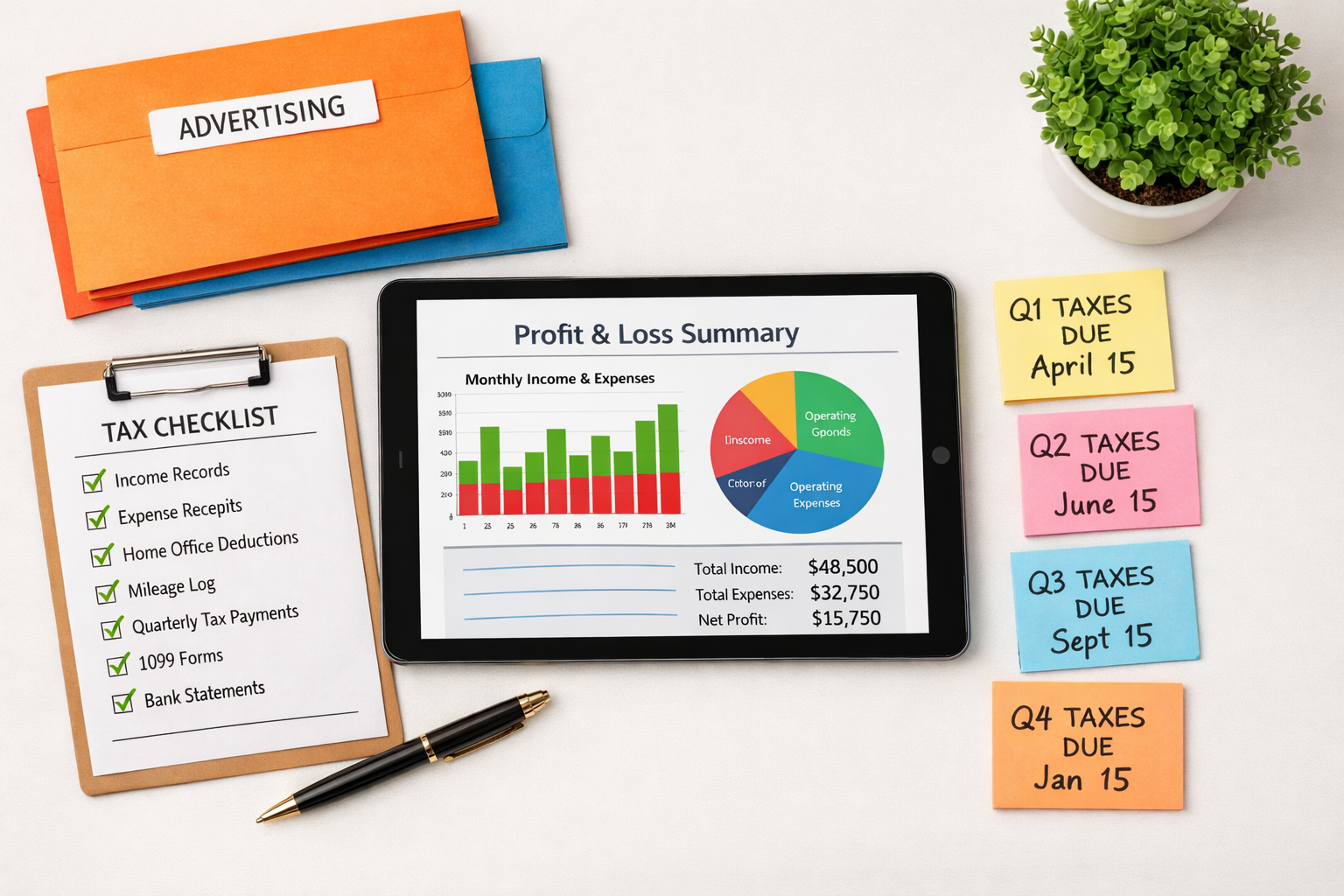
Good bookkeeping is the foundation of every other financial decision. Without accurate books, your accountant can’t do their job well, and you can’t make informed business decisions.
Weekly bookkeeping checklist for online business owners:
- Reconcile bank and payment processor accounts. Match transactions from Stripe, PayPal, Shopify Payments, and your bank account to your accounting software.
- Categorize all transactions. Don’t leave anything in “uncategorized.” Every expense should have a clear category.
- Save receipts digitally. Use an app like Dext, Hubdoc, or even your phone’s camera. The IRS requires documentation for deductions.
- Record any cash transactions. If you receive payments outside of your normal platforms, log them immediately.
- Review accounts receivable. Follow up on outstanding invoices.
Monthly tasks:
- Review your profit and loss statement
- Check your cash flow forecast for the next 30–60 days
- Set aside money for estimated taxes (a common rule of thumb is 25–30% of net profit)
- Review subscription charges for tools you may no longer use
Many online business owners find that outsourced bookkeeping services handle these tasks more efficiently than doing it themselves. Virtual bookkeeping services are particularly well-suited for digital businesses because everything is already cloud-based.
Edge case: If you sell on multiple platforms (Amazon + Etsy + your own website), reconciliation gets complicated fast. Each platform has its own fee structure and payout schedule. This is one of the strongest reasons to hire professional bookkeeping services for small business.
What Are the Biggest Financial Mistakes Online Business Owners Make?
Knowing what to avoid is just as valuable as knowing what to do. These are the most common and costly financial mistakes I see online entrepreneurs make:
1. Mixing personal and business money. This makes bookkeeping a nightmare and weakens your liability protection if you’re an LLC.
2. Ignoring sales tax obligations. Many online sellers assume sales tax doesn’t apply to them. It almost certainly does if you sell physical goods, and increasingly applies to digital products too.
3. Not tracking cost of goods sold (COGS). If you sell products, your COGS (materials, manufacturing, shipping to you) directly reduces your taxable income. Failing to track it means you’re overpaying on taxes.
4. Forgetting about self-employment tax. Beyond income tax, self-employed individuals owe an additional 15.3% on net earnings for Social Security and Medicare. Many new business owners are shocked by this at tax time.
5. Waiting until April to think about taxes. Tax planning is a year-round activity. By the time you’re filing, it’s too late to implement most strategies.
6. Using the wrong accounting method. Most small online businesses use cash basis accounting (recording income when received and expenses when paid). But if you carry inventory, the IRS may require accrual basis accounting. Your accountant can advise which method is right for you.
7. Not keeping records of home office use. The home office deduction is legitimate and valuable, but you need documentation: square footage of your dedicated workspace, total home square footage, and related expenses.
How Much Does an Accountant for Online Business Owners Cost?
Costs vary based on the complexity of your business, your location, and the services you need. Here’s a general range based on common service tiers:
| Service | Typical Cost Range (Annual) |
|---|---|
| Tax preparation only (sole proprietor, simple) | $300–$800 |
| Tax preparation (LLC or S-corp) | $800–$2,500 |
| Monthly bookkeeping (small online business) | $200–$600/month |
| Tax planning + preparation (year-round advisory) | $1,500–$5,000+ |
| Full-service (bookkeeping + tax planning + filing) | $3,000–$8,000+ |
Note: These are estimates based on common industry ranges for small businesses. Your actual costs will depend on transaction volume, number of states, entity type, and the specific professional you hire.
Many online business owners start with tax preparation services only and add bookkeeping as they grow. The cost of a good accountant almost always pays for itself through tax savings and avoided penalties. For more detail on pricing, check out our breakdown of tax accountant fees for individuals and businesses.
How to Find the Right Accountant for Your Online Business
Not every accountant understands the nuances of online business. Here’s how to find one who does:
Step 1: Define what you need. Are you looking for tax filing assistance only, or do you also need bookkeeping services and year-round tax planning? Knowing this narrows your search.
Step 2: Look for ecommerce or online business experience. Ask potential accountants directly: “How many online business clients do you currently serve?” and “Are you familiar with platforms like Shopify, Amazon Seller Central, or Stripe?”
Step 3: Check credentials. A CPA (Certified Public Accountant) has passed a rigorous exam and meets continuing education requirements. An EA (Enrolled Agent) is federally licensed to represent taxpayers before the IRS. Both are solid choices for tax work.
Step 4: Ask about their tech stack. A good accountant for online businesses should be comfortable with cloud accounting software, digital document sharing, and integrating with your ecommerce platforms.
Step 5: Compare pricing structures. Some accountants charge hourly, others offer flat monthly or annual fees. For online businesses with predictable transaction volumes, flat-fee arrangements often provide better value.
Step 6: Schedule a consultation. Most accountants offer an initial meeting (free or low-cost) to assess your needs. Use this time to evaluate their communication style and expertise.
You can start your search by browsing our directory to find tax accountants near you who specialize in small business and ecommerce clients.
Frequently Asked Questions
Do I need an accountant if my online business is just a side hustle? Yes, even side income is taxable. If you earn more than $400 in net self-employment income, you must file and pay self-employment tax. An accountant can help you claim deductions you might not know about, potentially offsetting much of that tax.
Can I just use tax software instead of hiring an accountant? Tax software works for simple situations, but online businesses with multiple income streams, multi-state sales, or entity elections benefit significantly from professional guidance. Software can’t advise you on tax strategy.
What’s the difference between a bookkeeper and an accountant? A bookkeeper records and organizes your financial transactions. An accountant analyzes that data, prepares tax returns, and provides strategic advice. Many online business owners need both services.
How often should I meet with my accountant? At minimum, quarterly. This aligns with estimated tax payment deadlines and gives you regular check-ins on your financial health. Monthly meetings are ideal if your accountant also handles bookkeeping.
What records should I keep and for how long? Keep all business financial records, including bank statements, receipts, invoices, and tax returns, for at least three years from the filing date. If you underreported income by more than 25%, the IRS can go back six years.
Is the home office deduction a red flag for audits? No, not if you qualify and document it properly. The IRS allows the home office deduction for a space used regularly and exclusively for business. You can use the simplified method ($5 per square foot, up to 300 square feet) or the regular method based on actual expenses.
Do I need a separate business entity to deduct business expenses? No. Sole proprietors can deduct business expenses on Schedule C. However, forming an LLC or S-corp may provide additional tax benefits and liability protection as your business grows.
Should I use cash or accrual accounting for my online business? Most small online businesses use cash basis accounting because it’s simpler. However, if you carry significant inventory, the IRS may require accrual basis. Your accountant can determine which method is appropriate.
How do I handle income from multiple platforms? Each platform may send you a 1099-K. Your accountant will help you reconcile these forms with your actual income, account for fees and refunds, and ensure nothing is double-counted or missed.
What retirement accounts can I use as a self-employed online business owner? You have several options: SEP-IRA (contribute up to 25% of net self-employment income), Solo 401(k) (higher contribution limits if you’re the only employee), or a traditional/Roth IRA. These contributions reduce your taxable income.
Conclusion
Managing the finances of an online business doesn’t have to be overwhelming, but it does require intention and the right support. The most important steps you can take right now are: separate your business and personal finances, start tracking expenses consistently, and connect with a professional tax accountant who understands online business.
Your action steps for this week:
- Open a dedicated business bank account if you don’t have one
- Set up or update your accounting software and categorize recent transactions
- Calculate whether you owe quarterly estimated taxes and mark the next deadline
- Schedule a consultation with an accountant experienced in ecommerce or online services
- Review your business entity structure to see if a change could save you on taxes
The financial tips in this guide are a starting point. Every online business is different, and a qualified accountant can tailor advice to your specific situation, platforms, and goals. If you’re ready to find the right professional, start by searching for a tax accountant who fits your needs.
References
- South Dakota v. Wayfair, Inc., 585 U.S. ___ (2018). Supreme Court of the United States.
- IRS, “Self-Employment Tax (Social Security and Medicare Taxes),” Publication 334, 2024. https://www.irs.gov/businesses/small-businesses-self-employed/self-employment-tax-social-security-and-medicare-taxes
- IRS, “Estimated Taxes,” 2024. https://www.irs.gov/businesses/small-businesses-self-employed/estimated-taxes
- IRS, “Home Office Deduction,” 2024. https://www.irs.gov/businesses/small-businesses-self-employed/home-office-deduction
- IRS, “Understanding Your Form 1099-K,” 2024. https://www.irs.gov/businesses/understanding-your-form-1099-k
<code class="language-html"><!DOCTYPE html>
<html lang="en">
<head>
    <meta charset="UTF-8">
    <meta name="viewport" content="width=device-width, initial-scale=1.0">
    <title>Online Business Tax Deduction Estimator</title>
    <style>
        .cg-element-calculator {
            font-family: -apple-system, BlinkMacSystemFont, 'Segoe UI', Roboto, sans-serif;
            max-width: 680px;
            margin: 2rem auto;
            background: #ffffff;
            border: 1px solid #e2e8f0;
            border-radius: 12px;
            overflow: hidden;
            box-shadow: 0 4px 12px rgba(0,0,0,0.08);
        }
        .cg-element-header {
            background: linear-gradient(135deg, #1e3a5f, #2d5a8e);
            color: #ffffff;
            padding: 1.5rem 2rem;
            text-align: center;
        }
        .cg-element-header h2 {
            margin: 0 0 0.25rem 0;
            font-size: 1.4rem;
            font-weight: 700;
        }
        .cg-element-header p {
            margin: 0;
            font-size: 0.9rem;
            opacity: 0.85;
        }
        .cg-element-body {
            padding: 1.5rem 2rem;
        }
        .cg-element-field {
            margin-bottom: 1.25rem;
        }
        .cg-element-field label {
            display: block;
            font-size: 0.9rem;
            font-weight: 600;
            color: #334155;
            margin-bottom: 0.4rem;
        }
        .cg-element-field small {
            display: block;
            font-size: 0.78rem;
            color: #64748b;
            margin-bottom: 0.3rem;
        }
        .cg-element-field input[type="number"] {
            width: 100%;
            padding: 0.65rem 0.85rem;
            border: 1px solid #cbd5e1;
            border-radius: 8px;
            font-size: 1rem;
            color: #1e293b;
            box-sizing: border-box;
            transition: border-color 0.2s;
        }
        .cg-element-field input[type="number"]:focus {
            outline: none;
            border-color: #2d5a8e;
            box-shadow: 0 0 0 3px rgba(45,90,142,0.15);
        }
        .cg-element-field select {
            width: 100%;
            padding: 0.65rem 0.85rem;
            border: 1px solid #cbd5e1;
            border-radius: 8px;
            font-size: 1rem;
            color: #1e293b;
            box-sizing: border-box;
            background: #fff;
        }
        .cg-element-btn {
            display: block;
            width: 100%;
            padding: 0.85rem;
            background: #2d5a8e;
            color: #fff;
            border: none;
            border-radius: 8px;
            font-size: 1.05rem;
            font-weight: 600;
            cursor: pointer;
            transition: background 0.2s;
            margin-top: 0.5rem;
        }
        .cg-element-btn:hover {
            background: #1e3a5f;
        }
        .cg-element-results {
            display: none;
            margin-top: 1.5rem;
            padding: 1.25rem;
            background: #f0f7ff;
            border-radius: 10px;
            border: 1px solid #bfdbfe;
        }
        .cg-element-results h3 {
            margin: 0 0 1rem 0;
            font-size: 1.1rem;
            color: #1e3a5f;
        }
        .cg-element-result-row {
            display: flex;
            justify-content: space-between;
            align-items: center;
            padding: 0.55rem 0;
            border-bottom: 1px solid #dbeafe;
            font-size: 0.92rem;
            color: #334155;
        }
        .cg-element-result-row:last-child {
            border-bottom: none;
        }
        .cg-element-result-row.cg-element-total {
            font-weight: 700;
            font-size: 1.05rem;
            color: #1e3a5f;
            border-top: 2px solid #2d5a8e;
            border-bottom: none;
            padding-top: 0.85rem;
            margin-top: 0.5rem;
        }
        .cg-element-result-value {
            font-weight: 600;
        }
        .cg-element-note {
            margin-top: 1rem;
            font-size: 0.78rem;
            color: #64748b;
            line-height: 1.5;
        }
        @media (max-width: 600px) {
            .cg-element-body {
                padding: 1rem 1.25rem;
            }
            .cg-element-header {
                padding: 1.25rem 1.25rem;
            }
        }
    </style>
</head>
<body>
    <div class="cg-element-calculator">
        <div class="cg-element-header">
            <h2>Online Business Tax Deduction Estimator</h2>
            <p>Estimate your potential deductions and tax savings</p>
        </div>
        <div class="cg-element-body">
            <div class="cg-element-field">
                <label>Annual Gross Revenue ($)</label>
                <input type="number" id="cg-revenue" placeholder="e.g. 75000" min="0">
            </div>
            <div class="cg-element-field">
                <label>Cost of Goods Sold ($)</label>
                <small>Materials, manufacturing, shipping to you</small>
                <input type="number" id="cg-cogs" placeholder="e.g. 15000" min="0">
            </div>
            <div class="cg-element-field">
                <label>Software & Platform Fees ($)</label>
                <small>Shopify, hosting, email tools, design apps</small>
                <input type="number" id="cg-software" placeholder="e.g. 3600" min="0">
            </div>
            <div class="cg-element-field">
                <label>Advertising & Marketing ($)</label>
                <input type="number" id="cg-ads" placeholder="e.g. 6000" min="0">
            </div>
            <div class="cg-element-field">
                <label>Payment Processing Fees ($)</label>
                <small>Stripe, PayPal, credit card fees</small>
                <input type="number" id="cg-processing" placeholder="e.g. 2200" min="0">
            </div>
            <div class="cg-element-field">
                <label>Home Office Size (sq ft)</label>
                <small>Dedicated workspace only (max 300 for simplified method)</small>
                <input type="number" id="cg-homeoffice" placeholder="e.g. 150" min="0" max="300">
            </div>
            <div class="cg-element-field">
                <label>Other Business Expenses ($)</label>
                <small>Education, professional services, shipping, supplies</small>
                <input type="number" id="cg-other" placeholder="e.g. 4000" min="0">
            </div>
            <div class="cg-element-field">
                <label>Filing Status</label>
                <select id="cg-status">
                    <option value="single">Single</option>
                    <option value="married">Married Filing Jointly</option>
                </select>
            </div>
            <button class="cg-element-btn" onclick="cgCalculate()">Estimate My Tax Savings</button>
            <div class="cg-element-results" id="cg-results">
                <h3>Your Estimated Breakdown</h3>
                <div class="cg-element-result-row">
                    <span>Gross Revenue</span>
                    <span class="cg-element-result-value" id="cg-r-revenue">$0</span>
                </div>
                <div class="cg-element-result-row">
                    <span>Total Deductions</span>
                    <span class="cg-element-result-value" id="cg-r-deductions">$0</span>
                </div>
                <div class="cg-element-result-row">
                    <span>Net Taxable Business Income</span>
                    <span class="cg-element-result-value" id="cg-r-net">$0</span>
                </div>
                <div class="cg-element-result-row">
                    <span>Estimated Self-Employment Tax (15.3%)</span>
                    <span class="cg-element-result-value" id="cg-r-se">$0</span>
                </div>
                <div class="cg-element-result-row">
                    <span>Estimated Income Tax</span>
                    <span class="cg-element-result-value" id="cg-r-income">$0</span>
                </div>
                <div class="cg-element-result-row cg-element-total">
                    <span>Estimated Total Tax</span>
                    <span class="cg-element-result-value" id="cg-r-total">$0</span>
                </div>
                <div class="cg-element-result-row cg-element-total" style="color:#16a34a; border-top-color:#16a34a;">
                    <span>Estimated Tax Saved by Deductions</span>
                    <span class="cg-element-result-value" id="cg-r-saved">$0</span>
                </div>
                <p class="cg-element-note">This is a simplified estimate for educational purposes only. It does not account for state taxes, QBI deduction, retirement contributions, or other credits. Consult a professional tax accountant for accurate calculations specific to your situation.</p>
            </div>
        </div>
    </div>
    <script>
        function cgVal(id) {
            var v = parseFloat(document.getElementById(id).value);
            return isNaN(v) || v < 0 ? 0 : v;
        }
        function cgFmt(n) {
            return '$' + Math.round(n).toLocaleString('en-US');
        }
        function cgIncomeTax(taxable, status) {
            var brackets, tax = 0, prev = 0;
            if (status === 'married') {
                brackets = [[23200,0],[46200,0.10],[94300,0.12],[201050,0.22],[383900,0.24],[487450,0.32],[731200,0.35],[Infinity,0.37]];
            } else {
                brackets = [[11600,0],[23200,0.10],[47150,0.12],[100525,0.22],[191950,0.24],[243725,0.32],[609350,0.35],[Infinity,0.37]];
            }
            for (var i = 0; i < brackets.length; i++) {
                if (taxable <= 0) break;
                var limit = brackets[i][0] - prev;
                var rate = brackets[i][1];
                var amount = Math.min(taxable, limit);
                tax += amount * rate;
                taxable -= amount;
                prev = brackets[i][0];
            }
            return tax;
        }
        function cgCalculate() {
            var revenue = cgVal('cg-revenue');
            var cogs = cgVal('cg-cogs');
            var software = cgVal('cg-software');
            var ads = cgVal('cg-ads');
            var processing = cgVal('cg-processing');
            var ho = Math.min(cgVal('cg-homeoffice'), 300);
            var homeDeduction = ho * 5;
            var other = cgVal('cg-other');
            var status = document.getElementById('cg-status').value;
            var totalDeductions = cogs + software + ads + processing + homeDeduction + other;
            var net = Math.max(revenue - totalDeductions, 0);
            var seBase = net * 0.9235;
            var seTax = seBase * 0.153;
            var seDeduction = seTax / 2;
            var taxableIncome = Math.max(net - seDeduction, 0);
            var incomeTax = cgIncomeTax(taxableIncome, status);
            var totalTax = seTax + incomeTax;
            var noDeductNet = revenue;
            var noDeductSE = (noDeductNet * 0.9235) * 0.153;
            var noDeductTaxable = Math.max(noDeductNet - (noDeductSE / 2), 0);
            var noDeductIncome = cgIncomeTax(noDeductTaxable, status);
            var noDeductTotal = noDeductSE + noDeductIncome;
            var saved = Math.max(noDeductTotal - totalTax, 0);
            document.getElementById('cg-r-revenue').textContent = cgFmt(revenue);
            document.getElementById('cg-r-deductions').textContent = cgFmt(totalDeductions);
            document.getElementById('cg-r-net').textContent = cgFmt(net);
            document.getElementById('cg-r-se').textContent = cgFmt(seTax);
            document.getElementById('cg-r-income').textContent = cgFmt(incomeTax);
            document.getElementById('cg-r-total').textContent = cgFmt(totalTax);
            document.getElementById('cg-r-saved').textContent = cgFmt(saved);
            document.getElementById('cg-results').style.display = 'block';
        }
    </script>
</body>
</html>
</code>
SEO Meta Title: Accountant for Online Business Owners: Financial Tips (2026)
SEO Meta Description: Financial tips from an accountant for online business owners. Learn tax deductions, bookkeeping practices, and when to hire a CPA for your ecommerce business.
